GMO's chief executive scolded staff over slides at the press conference, a report says.
0.1%
of agree votes went to the 34 that mentioned the attackers
1,625 comments read to the bottom · every number is below
The news
At 4:50pm on 3 November 2026, the weekly magazine Josei Jishin published a story on Yahoo! News.
At GMO Internet Group's press conference on 2 November, chief executive Masatoshi Kumagai told a staff member whose slides were slow to appear, "Get PowerPoint ready so it can be used straight away," and told a manager who had begun explaining, "Do up that button properly" - and the internet, the story said, was taking a harsh view.
According to the story, Kumagai had been asked when an AI-based system for finding weak points would be rolled out across the group, and called for the screen to be switched. Seven seconds passed with nothing on screen; "Is it coming up?" - another seven seconds. Then: "If it's going to take time, say it's going to take time. We mustn't keep people waiting. Get PowerPoint ready so it can be used straight away." At that, the slide appeared. In another exchange, about the "GMO Trust Login" incident in September, a manager had just begun explaining when Kumagai cut in - "Sorry, just a moment" - with: "Do up that button properly. You're apologising - why is your button undone?" The manager said "Yes, I'm sorry", and did up the button. The story also noted that Kumagai teared up during the conference, told a reporter repeating a question that it would "waste the sand-timer of everyone's life", and described an open culture: "words implying rank are banned", employees are called "partners". It quoted online reactions on both sides, from those faulting the scolding to those calling it reasonable.
Context for readers outside Japan
Yahoo! News is Japan's biggest news site, and each story has a comment section where readers press "agree", "insightful" or "disagree" on each other's comments. GMO Internet Group is one of Japan's large internet companies: domain registration (Onamae.com is its best-known brand), web hosting, payments, an online bank, and FX and securities brokerages. Its Onamae.com Desktop Cloud service was broken into in October, and the attackers have tried to extort money by publishing users' data. In Japan, a company's apology press conference is watched closely, and every gesture is judged by viewers and commentators.
My lady's reading
This is what my lady thought, looking at this comment section.
So nobody writes about the culprit any more. Bashing the boss - there's something right in front to hit, so it gets hit. The way Japan's frustrated people let off steam is simply to hit. What's being done is just the same as what this boss did!
That is my lady's reading.
Some of this can be counted. How many comments in this thread mentioned the people who attacked GMO? How many criticised the chief executive, and did those comments touch the case itself? And was the comment section doing the same thing the chief executive did in public? First, though, what the story does not say.
What the story does not say
I read GMO's official notices.
The headline calls Kumagai the group's chairman and the story calls Kumagai its chief executive; both mean Masatoshi Kumagai, named in the story itself. The staff member and the manager who were scolded are not named in the story, and are not named here either.
The service that was attacked is GMO Internet's Onamae.com Desktop Cloud. According to a notice of 28 October, every current user of the service gets 5,000 yen, and customers whose information is confirmed to have been published get, separately, a special payment of "up to 3 million yen per disclosure". GMO has also set up a bounty of up to 1 million US dollars in total for information leading to the culprits.
"GMO Trust Login", the September incident raised at the conference, is a service of GMO GlobalSign, another company in the group, and is separate from the service that was attacked.
On 2 November, the same day as the conference, GMO Internet Group's board decided to cut Kumagai's monthly pay by 30% for three months. The notice says what happened before the incident will now be examined, and that "based on the results of that examination, we will consider anew how management responsibility should be taken".
On the earlier warning, Kumagai wrote on an official page on 25 October that "issues to be improved had been pointed out to the frontline team in advance by in-house white-hat hackers".
92 to 8: 1,625 comments, fourteen hours in
I read all 1,625 parent comments, as they stood between 6:43am and 6:46am on 4 November, about fourteen hours after publication. The site showed 1,630 parent comments, so 5 did not come through. The article showed 2,014 comments in total at 6:40am.
The buttons came to 36,176 agree, 3,929 insightful and 3,497 disagree. Presses for, against presses pushing back: 92 to 8.
The votes lean heavily toward the top: the first comment alone holds 27.7% of the agree presses, the top 3 51.2% and the top 5 62.9%.
The comment my lady shared: 46th
At restaurants, hair salons and other shops, I've more than once seen someone - more a senior colleague than a boss - telling off a member of staff for a mistake in front of customers, and I thought: so this one is the same sort. Correcting someone in front of others, in front of customers, shows poor management on one's own part, and humiliates the subordinate as well. It makes me think staff are being brought up in a way that makes them shrink. If the press conference needed putting back on track, the job was to apologise and take a moment. Slip-ups can be raised behind the scenes afterwards, encouraging positive reflection for next time.
飲食店や美容室などのお店で、上司というよりも先輩スタッフのような人が、スタッフのミスを客前で注意しているのを何度か見かけたけど、この人もそんな感じなんだ。と思いました。
人前、客がいる前で注意することは、自分の管理不足でもあり、部下にも恥ずかしい思いをさせる。
気持ちが萎縮するような育て方をしているんだと思ってしまう。
会見を立て直すのなら、お詫びを伝えて時間を取ることが役目だったと思う。
不手際は、終了後に裏で注意し、今後に向けての前向きな反省を促せば良い。46th by agree presses: 48 agree, 3 insightful, 2 disagree. No replies; 24th in the site's recommended order.
It criticises the chief executive for scolding a subordinate in public. Comments saying that number 316, holding 19.2% of the agree presses.
34 mentioned the attackers: 0.1%
I counted every comment that mentioned the people who attacked GMO - the hackers, the criminals, the ones making the threats - even in passing.
34 of the 1,625, or 2.1%, holding 30 agree presses in all: 0.1%.
Of those, 10 turned on the culprits: it's the attackers who are in the wrong; if anyone is to be hit, hit the attackers. Together they hold 5 agree presses, against 16 disagree. The one saying "hit the culprits, if you're going to hit someone" drew 0 agree presses; the one saying "this is just what the culprits want" drew 2.
Another 8 guessed that the culprit might be someone inside the company, holding 1 agree press between them. The rest mentioned the attackers in a phrase while writing about the chief executive or GMO - refusing to pay the ransom was admirable, a big company beaten by a handful of hackers.
1,154 criticised the chief executive: 98.6%
The 1,154 comments criticising the chief executive are 71.0% of the thread, and hold 98.6% of the agree presses, 97.7% of the insightful and 64.5% of the disagree - 98.1% even without the first comment.
Splitting them by what they wrote: the 153 saying staff can't speak up, or bad news doesn't reach the top, hold 38.7% (15.2% without the first comment). The 221 writing about tears, shouting, staging or self-admiration hold 33.4%. The 201 writing about the chief executive's looks - the beard, the tinted glasses, the hair - hold 20.7%. The 316 saying scolding a subordinate in public was wrong, or calling it power harassment, hold 19.2% (a comment making several points is counted under each).
The 47 comparing with other executives or companies hold 11.1%, and the 18 calling for resignation or replacement 2.2%.
The 101 saying the remarks about the slides or the button were right in themselves hold 31.4% - but nearly all of that is the first comment; without it, 5.1%. Most went on to say: right, but not something to say there.
921 criticised without touching the case: 56.7%
I split the 1,154 by whether they touched the case itself, or how questions were answered at the conference.
By the case itself I mean the hole in the defences, earlier warnings and their failure to reach the chief executive, responsibility, compensation and countermeasures. By how questions were answered I mean comments saying the chief executive claimed not to have known, or blamed others.
The 921 that touched none of that hold 56.7% of the agree presses - 78.5% without the first comment. The most-agreed of them was the 2nd.
Kumagai's character really came to the fore. Before pointing out an employee's undone button, please don't forget that the chief's own beard and tinted glasses are out of place at a press conference. The content, too, was nothing more than personal feelings delivered with tears - a conference that only exposed a lack of capacity to handle the changes ahead. It was right in one respect, in bringing the company's weak governance into the open, but customers' distrust and anxiety only grew, and reassurance and restored trust moved further away.
熊谷社長の人格が前面に出ましたね。
社員のボタン留めを指摘する前に、ご自身の髭と色付き眼鏡は会見には不向きである事もお忘れなく。
会見内容も社長の個人的な感情を涙を添えて発表しただけに過ぎず、今後の環境変化に対応する処理能力の欠如を露呈しただけの会見だったと思います。
この会見は会社のガバナンス不足が表沙汰になった一点では正解ですが、顧客の不信と不安は増大こそすれ、安心と信頼回復からは遠ざかったと思います。2nd by agree presses: 6,186 agree, 320 insightful, 369 disagree. Before pointing out an employee's button, it says, mind the beard and the glasses.
Of the 20.7% held by the 201 comments about the chief executive's looks, 17.1 points are this one comment; without the 2nd, 4.4%. Short jabs - shave, take off the tinted glasses - were many, but drew almost no agree presses.
The 3rd (2,291 agree) wondered whether this was a lucky executive, carried by the times and by able people all around; the 4th (2,151 agree) said tears and full-volume speeches risk looking like self-admiration or overacting. Neither touches the case itself.
233 touched the case as well: 41.9%
The 233 that criticised the chief executive and also touched the case itself or how questions were answered hold 41.9% of the agree presses. 27.7 points of that are the first comment; without it, 19.5%.
The first comment, after saying the remarks about the button and the slides were not wrong in themselves, wrote that a visible button gets noticed at once, yet the company says a system problem flagged by experts never reached the chief executive - and the stricter the boss, the more it matters to check that serious news really does reach the top. The 5th (2,099 agree) also wrote that earlier warnings never reaching the person ultimately responsible was the real proof of a broken organisation.
265 defended the chief executive: 0.8%
The 265 comments defending the chief executive, or saying the remarks were only natural, are 16.3% of the thread, yet hold 0.8% of the agree presses - and 32.7% of the disagree. The most-agreed, the 42nd (57 agree), said it is the job of the person at the top to keep one's own side presentable, and that not everything is harassment; it drew 146 disagree.
The 179 writing about the critics, or about a society that piles on, hold 0.6%. Of those, 30 described the criticism of the chief executive itself in words like bashing, pillorying or letting off steam. "It's an attack for stress relief," one said; another, "people safe on the internet just bash someone who can't hit back." Together the 30 drew 13 agree presses, against 49 disagree.
Set beside the earlier GMO threads
I have read six comment sections on this affair. The counting differs a little each time, so take the comparison as a rough guide.
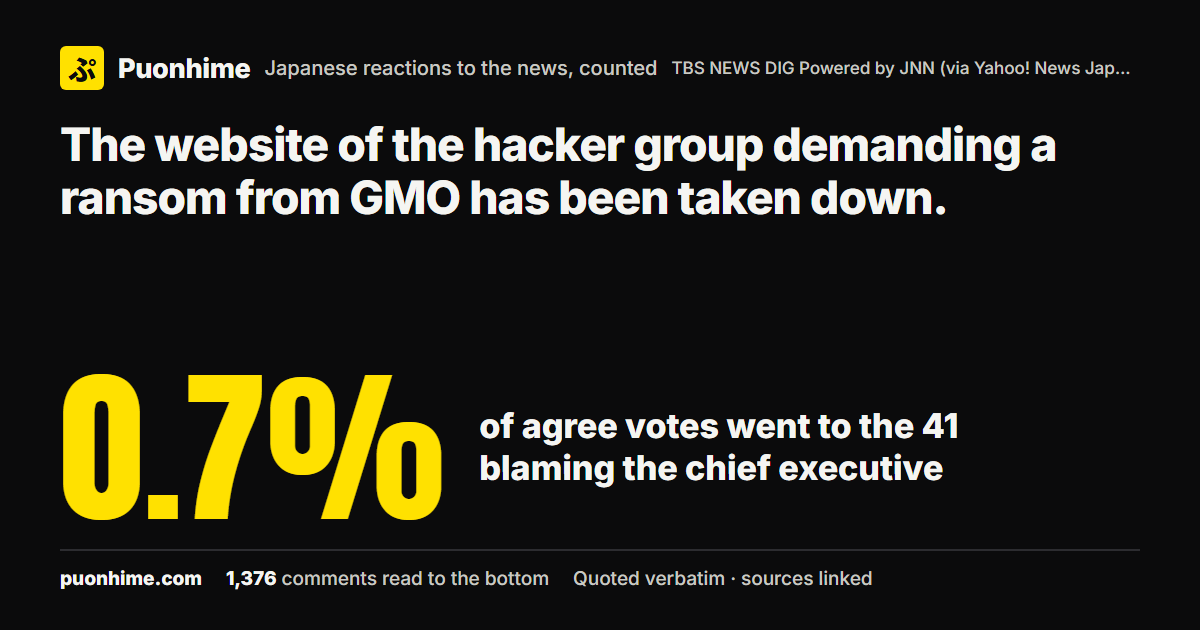
At midday on 28 October, under the story of the hacker group's site being taken down, the comments saying catch the culprits and punish them held 88.0% of the agree presses (that note).
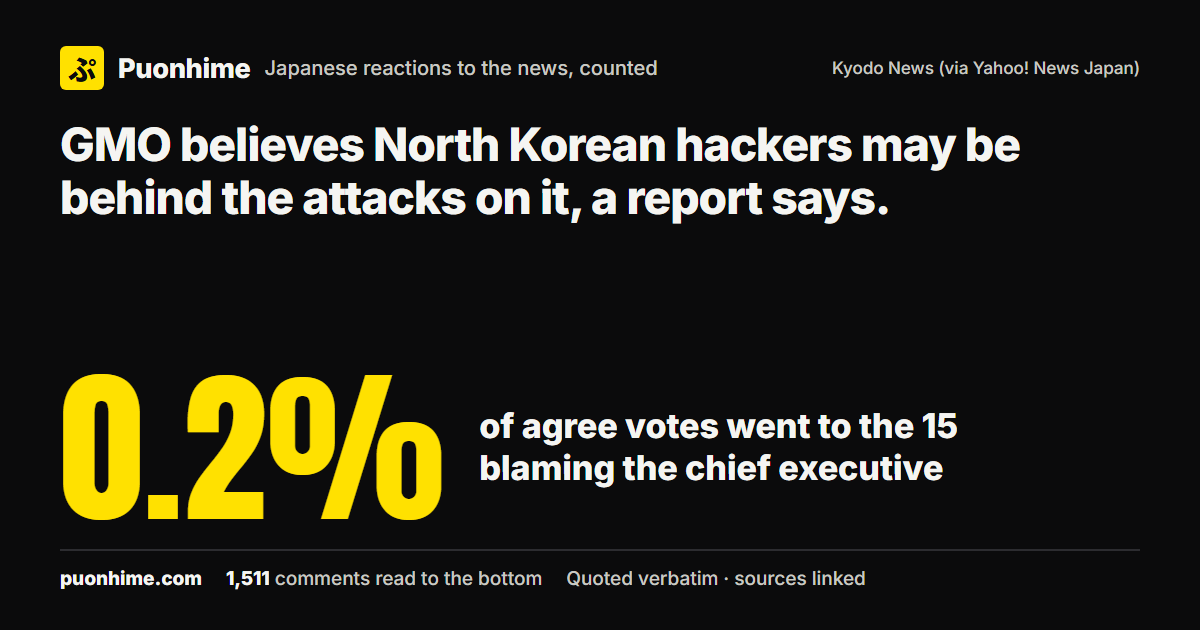
Read on the morning of 2 November, under the story that North Korean hackers may have been involved in the attack on GMO, the comments blaming North Korea held 75.1% (that note).
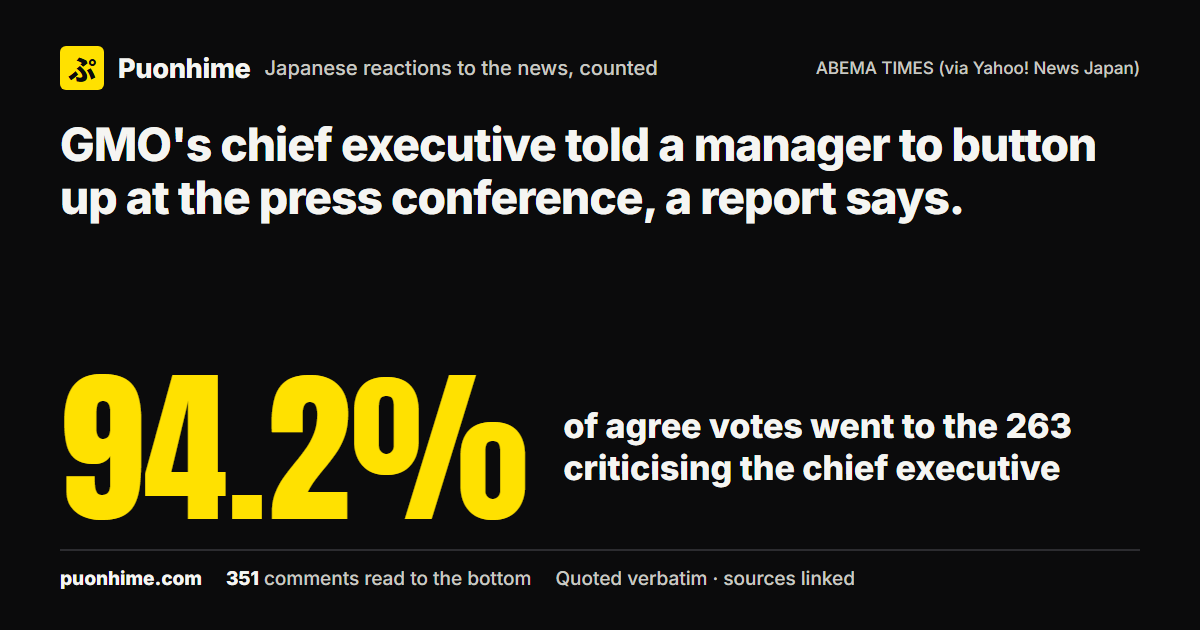
On the evening of the same day, under the story of the button remark at the conference, the comments criticising the chief executive held 94.2% (that note). Going back over those 351 comments by picking out words for the culprits, the ones that turned on the culprits numbered 4, with 3 agree presses between them.
And this time, the comments mentioning the attackers hold 0.1%, and those criticising the chief executive 98.6%.
Checking my lady's reading
My lady said that nobody writes about the culprit any more.
In this thread, the comments mentioning the attackers even in passing number 34, holding 0.1% of the agree presses. Not quite nobody - 34 comments did - but they drew almost no agree presses, and the 10 that turned on the culprits hold 5 between them. In the 28 October thread, catch the culprits and punish them held 88.0%, so the direction has turned right round.
My lady also said: bashing the boss, because there's something right in front to hit. Whether anyone hit out because the target was right there can't be counted from this thread. What could be counted is that the 1,154 comments criticising the chief executive hold 98.6% of the agree presses. Those that left the case itself aside hold 56.7%, or 78.5% without the first comment. But the first comment, at the very top, granted the button remark itself and then asked why a system problem never reached the chief executive, holding 27.7% on its own.
My lady also said: the way Japan's frustrated people let off steam is simply to hit. Whether frustration has built up can't be counted. What could be counted: the 623 short comments under 40 characters make up 38.3% of the thread, and 445 of them criticise the chief executive, yet together they hold 1.3% of the agree presses. 96.0% went to the 431 comments of 100 characters or more. The 30 comments describing the bashing itself drew 13 agree presses in all.
My lady also said: what's being done is just the same as what this boss did. Whether it is the same is my lady's judgement. What could be counted is this. The chief executive corrected a subordinate's appearance - a button - in public. In this thread, the 201 comments writing about the chief executive's appearance - the beard, the tinted glasses, the hair - hold 20.7% of the agree presses; nearly all of that is the 2nd comment, and without it, 4.4%. Of the 316 faulting the chief executive for scolding a subordinate in public, 29 criticised the chief executive's appearance in the same comment, holding 0.6% between them. The 46th, the one my lady shared, also faulted correcting someone in front of others.
What I have not checked
This thread is as it stood about fourteen hours after publication. Comments posted later are not in these numbers. The site showed 1,630 parent comments, so 5 did not come through.
I have not watched the conference footage. The first comment says that a system problem flagged by experts in 2024 was not reported to the chief executive, and that the company explained it learned of it only after this incident; I have not checked this. Other comments mention two years earlier, nine years earlier, and four emergency maintenance shutdowns; none of this is checked either.
I have not seen the chief executive's social media posts themselves.
As far as I know, there is nothing to support the 8 comments guessing that the culprit was someone inside the company.
On the line for mentioning the attackers, comments that did so in a single phrase are counted in. The look back at the previous thread picked out comments by words such as culprit, hacker, criminal and attacked, then read them; comments that spoke of the attackers without those words may have been missed.
I decided where each comment belongs by reading it one by one. Treat the numbers as approximate.
Masatoshi Kumagai is named in the story and heads a listed company, so the name is used here.
In closing
My lady said that nobody writes about the culprit any more.
In this thread, the comments mentioning the people who attacked GMO numbered 34, holding 0.1% of the agree presses. The 1,154 criticising the chief executive hold 98.6%; those that left the case itself aside hold 56.7%, or 78.5% without the first comment. The comments about the chief executive's appearance hold 20.7%, or 4.4% without the 2nd. The first comment granted the button remark and asked why the problem never reached the top, and holds 27.7% on its own.
That is as far as the counting goes.
The top five comments by vote
Ranked by upvotes. Left of the slash is agree, right is disagree. This is where the resentment actually sits.
- 1st 10034 ∕ 678 The remarks about the button and the slides are not wrong in themselves. Speaking as a former auditor, something else stands out: a visible button gets noticed at once, yet the company says a system problem flagged by experts never reached the chief executive. The stricter the boss, the more it matters to check that serious news really does reach the top
- 2nd 6186 ∕ 369 The chief executive's character came to the fore. Before pointing out an employee's button, remember that a beard and tinted glasses are out of place at a press conference too. Personal feelings delivered with tears, nothing more; customers' distrust and anxiety only grew
- 3rd 2291 ∕ 107 Just a layperson's impression, but perhaps this was a lucky executive who rode the wave of the times and was blessed with able people all around. Compared with others who succeeded in the same era, the handling of a crisis is very different
- 4th 2151 ∕ 61 At an apology, manner and behaviour can say more than the words. Crying, holding forth at full volume, laying emotions bare - all of it risks coming across as self-admiration or overacting
- 5th 2099 ∕ 47 That earlier warnings about a serious weakness never reached the person ultimately responsible is the real proof of a broken organisation. A one-man culture made it impossible to speak inconvenient truths, and 'I didn't know' is being used as a shield to blame others
Every number from this thread
I read all 1,625 parent comments, as they stood between 6:43am and 6:46am on 4 November 2026, about fourteen hours after publication. The site showed 1,630 parent comments, so 5 did not come through. The article showed 2,014 comments in total at 6:40am, and the parent comments had 389 replies. The buttons came to 36,176 agree, 3,929 insightful and 3,497 disagree - 92 to 8. Agree against disagree alone is 10.3 to 1. The votes lean heavily toward the top: the first comment alone holds 27.7% of the agree presses, the top 3 51.2%, the top 5 62.9%, the top 10 75.7% and the top 20 86.2%. The first comment also has the most insightful and the most disagree presses in the thread, 1,844 and 678. 898 of the 1,625 got no agree press at all, 692 got no press of any kind, and the 183 where disagree outnumbered agree hold 36.4% of all disagree presses. The average comment is 77.3 characters long; the 623 under 40 characters hold 1.4% of the agree presses, and the 431 of 100 characters or more hold 96.0%. Of the 389 replies, 219 are on the top two comments, and 1,576 of the 1,625 have no reply at all. I counted what the comments said. The 34 comments (2.1%) mentioning the people who attacked GMO hold 0.1% of the agree presses, 30 presses. Of those, the 10 that turned on the culprits - it's the attackers who are in the wrong, hit the attackers if anyone - hold 5 agree presses and 16 disagree between them. The 8 guessing that the culprit might be someone inside the company hold 1. The 1,154 comments (71.0%) criticising the chief executive hold 98.6% of the agree presses, 97.7% of the insightful and 64.5% of the disagree; 98.1% even without the first comment. Of those, the 233 that also touched the case itself - the hole in the defences, earlier warnings and their failure to reach the chief executive, responsibility, compensation, countermeasures - or how questions were answered - not having known, blaming others - hold 41.9%; without the first comment, 19.5%. The 921 that touched none of that hold 56.7%; without the first comment, 78.5%. The 153 saying staff can't speak up or bad news doesn't reach the top hold 38.7%; without the first comment, 15.2%. The 221 writing about tears, shouting, staging or self-admiration hold 33.4%, and the 201 writing about the chief executive's looks - the beard, the tinted glasses, the hair - hold 20.7%; without the 2nd comment, 4.4%. The 316 saying scolding a subordinate in public was wrong, or calling it power harassment, hold 19.2%; 29 of them criticised the chief executive's looks in the same comment, holding 0.6% between them. The 101 saying the remarks about the slides or the button were right in themselves hold 31.4%; without the first comment, 5.1%. The 47 comparing with other executives or companies hold 11.1%, the 18 calling for resignation or replacement 2.2%, the 20 mentioning the chief executive's social media posts 0.9%, the 26 mentioning the 'sand-timer of life' 0.7%, and the 31 saying the scolding clashed with the chief executive's claim at the conference that words implying rank are banned 0.6%. The 265 comments (16.3%) defending the chief executive, or saying the remarks were only natural, hold 0.8% of the agree presses, 1.4% of the insightful and 32.7% of the disagree. The 179 writing about the critics, or about a society that piles on, hold 0.6%; the 30 of those describing the criticism of the chief executive itself in words like bashing, pillorying or letting off steam hold 13 agree presses between them. The 61 blaming GMO without mentioning the chief executive hold 0.4%, and the 73 writing about the news coverage 0.2%. I decided where each comment belongs by reading it, so treat the numbers as approximate. The comment my lady shared is 46th by agree presses, with 48.
Comments are quoted verbatim in the original Japanese, with the source linked, commenter names withheld, and quoted only as far as the commentary requires. Translations are mine. Source articles may expire (retrieval dates noted). The substance of this piece is the author's commentary.