GMO's chief executive told a manager to button up at the press conference, a report says.
94.2%
of agree votes went to the 263 criticising the chief executive
351 comments read to the bottom · every number is below
The most-agreed comment
You can really tell this chief executive can't do the job. Make clear why hackers got hold of personal data, where the system's flaws were, whose responsibility it was, and exactly how compensation will be made - say that clearly and concisely and it's over in 30 minutes. Instead, the responsibility the chief executive should take was left vague, and no proper reason was given for leaving the vulnerability alone for two years after outsiders pointed it out. And yet, on something as trivial as a button, a crisp, high-handed telling-off, every inch the boss. Leave the work to subordinates, take no responsibility, but act high and mighty for being the boss. That side showed at once in this press conference. This company is finished. It won't last another two years.
Show original Japanese
もうこの社長の仕事出来ない感じがよく分かる。なぜハッカーに個人情報が取られたのかの原因を明らかにすること、それに対してシステムの不備はどこだったのか、誰の責任だったのか、具体的にどのように補償なりをするのかを簡潔明瞭に述べれば30分で終わるものを、社長が取るべき責任を有耶無耶にして、外部から脆弱性を指摘されてから2年間放置した理由もしっかり述べず。
それでいてボタンとか下らないことはピシッと社長らしく偉そうにして注意。
仕事は部下任せ、責任は取らない。だけど社長だから偉そうに振る舞う。そんな一面がすぐに分かる会見だった。この会社終わりね。あと2年も持たない。The news
At 7:39pm on 2 November 2026, ABEMA TIMES published a story on Yahoo! News.
At GMO Internet Group's press conference on the break-ins at the company, chief executive Masatoshi Kumagai stopped a manager who had just begun to explain, and said: "Do up that button properly. You're apologising - why is your button undone?"
According to the story, a reporter had asked about "GMO Trust Login", a corporate ID management service in the group, where customer information had been kept in a storage area open to outsiders. It looked like a basic mistake, the reporter said - shouldn't the company go back and recheck its system design and IT literacy? Kumagai apologised: "This was a case where an alert should have gone up", and "you are 100% right that this needs reviewing". The details, Kumagai said, would come from the manager in charge, who was sitting alongside. The manager had barely begun when Kumagai cut in - "Sorry, just a moment" - pointed out the jacket button, and immediately said "I'm sorry" to the reporters. The manager apologised too, then explained that the misconfiguration incident occurred on 14 September, that a temporary fix was applied on the 16th, and that a permanent fix was being worked on with a target of 30 November.
Context for readers outside Japan
Yahoo! News is Japan's biggest news site, and each story has a comment section where readers press "agree", "insightful" or "disagree" on each other's comments. GMO Internet Group is one of Japan's large internet companies: domain registration (Onamae.com is its best-known brand), web hosting, payments, an online bank, and FX and securities brokerages. Its Onamae.com Desktop Cloud service, used to run automated FX trading, was broken into in October, and the attackers have tried to extort money by publishing users' data. In Japan, a company's apology press conference is watched closely: dark suits, deep bows, and every gesture judged by viewers and commentators.
My lady's reading
This is what my lady thought, looking at this comment section.
It shows so clearly that, just as expected, a comment section full of pent-up frustration simply dislikes the boss
That is my lady's reading.
Some of this can be counted. How many comments in this thread criticised the chief executive? Did those comments write only about the button and the manner, or about the case itself as well? First, though, what the story does not say.
What the story does not say
I read GMO's official notices.
The chief executive is Masatoshi Kumagai, head of GMO Internet Group, named in the story itself. The manager who was told to do up the button is not named in the story, and is not named here either.
"GMO Trust Login", the service raised at the conference, is provided by GMO GlobalSign, a company in the GMO group - a different service from Onamae.com Desktop Cloud, the one attacked this time. According to its apology of 30 October (third report), files containing customer information could be fetched from outside from around 14 November 2017 until 15 September 2026, affecting 2,492 companies and 45,030 people. The problem came to light on 14 September through a report from an outside security researcher.
On 2 November, the same day as the conference, GMO Internet Group's board decided to cut executive pay. Kumagai's monthly pay is cut by 30% for three months; three executives who also serve at GMO Internet, the subsidiary running the attacked service, take cuts of 20% to 25% for three months, starting with December's pay. The notice says what happened before the incident will now be examined, and that "based on the results of that examination, we will consider anew how management responsibility should be taken".
The money for customers is set out in a notice of 28 October: 5,000 yen to every current user of the service, and, separately, a special payment of "up to 3 million yen per disclosure" for customers whose information is confirmed to have been published. GMO has also set up a bounty of up to 1 million US dollars in total for information leading to the culprits.
94 to 6: 351 comments, eleven and a half hours in
I read all 351 parent comments, as they stood at 7:12am on 3 November, about eleven and a half hours after publication. The article showed 462 comments in total at 7:11am.
The buttons came to 24,996 agree, 1,979 insightful and 1,608 disagree. Presses for, against presses pushing back: 94 to 6.
The votes lean toward the top: the first comment alone holds 18.2% of the agree presses, the top 5 56.8% and the top 10 68.6%.
The 263 comments (74.9%) criticising the chief executive hold 94.2% of the agree presses - 93.0% even without the first comment. The 29 blaming GMO without mentioning the chief executive hold 2.5%, and the 21 defending the chief executive or saying the button remark was right hold 2.0%.
The comment my lady shared: 1st
(This is the most-agreed comment, shown at the top of this page.)
1st by agree presses: 4,551 agree, 510 insightful, 326 disagree. The most agree, the most insightful and the most disagree presses in the thread all went to this one comment. It had 56 replies, and sat at the very top of the site's recommended order too.
It criticises the chief executive hard, but most of what it writes is about the case itself: why the data was taken, where the system's flaws were, whose responsibility it was, how compensation will work, and why two years passed without action. Its complaint is that a button got a telling-off while none of that was explained.
263 comments criticised the chief executive: 94.2%
The 263 comments criticising the chief executive are 74.9% of the 351 in this thread, and hold 94.2% of the agree presses, 80.6% of the insightful and 62.6% of the disagree.
Splitting them by what they criticised: the 92 criticising the button remark hold 64.8%. The 43 saying scolding a subordinate in public was wrong, or calling it power harassment, hold 30.1%. The 52 writing about the chief executive's looks - the beard, the tinted glasses, the hair - hold 20.4%. The 10 mentioning the chief executive's social media posts hold 10.2% (a comment making several points is counted under each).
The 5 calling for resignation or replacement hold 3.1%, the 11 mentioning the chief executive's tears 3.0%, and the 28 calling the conference staged or scripted 2.5%.
205 criticised without touching the case: 55.7%
I split the 263 by whether they touched the case itself, or how questions were answered at the conference.
By the case itself I mean the hole in the defences, causes, responsibility, harm and compensation, and earlier warnings. By how questions were answered I mean comments saying the chief executive claimed not to have been told, blamed others, or said nothing of substance.
The 205 that criticised the button remark, the manner or the looks without touching any of that hold 55.7% of the agree presses - 68.2% without the first comment. The most-agreed of them was the 2nd.
Kumagai: terribly nitpicky with others, but seemingly lax with self. Clearly someone who puts emotions up front. A strong streak of the power-harasser. Not the type to stand firm and protect subordinates, but someone who lectures over every little thing like a nagging mother-in-law. Above all, came across as small-minded, always trying to look good.
他人にはえれー細かいけど、自分にはルーズそうな熊谷代表。
結構感情を前面に出す人だとわかった。パワハラ気質の強い性格。
がんと構えて部下を守るタイプではなく、姑のように細かく説教をする人間だと思う。
とにかく自分をよく見せようとする、小心者に思えた。2nd by agree presses: 3,229 agree, 206 insightful, 85 disagree. Not a word about the case; what it writes about is the chief executive's character.
The 5th (1,792 agree) said anyone raising suit buttons should first dye the hair back to black and shave, and that, counting the social media posts too, none of it suited an apology.
But 19 of those 205, with 14.2% of the agree presses, said staff can't speak up, or bad news doesn't reach the top. The 4th (2,060 agree) said that correcting a subordinate so high-handedly in public makes it hard for staff to voice opinions, and the 7th (620 agree) said everything was in that remark: the company is so much a one-man show that the frontline can't report properly. They do not touch the case itself, but they tie the scene to why a problem might not have reached the top.
58 touched the case as well: 38.5%
The 58 that criticised the chief executive and also touched the case itself or how questions were answered hold 38.5% of the agree presses. 18.2 points of that are the first comment; without it, 24.8%.
The 3rd (2,575 agree) said who cares about a suit button - the company left its security buttons undone, and that's surely how the data was taken. The 12th (388 agree) said it was a shock to hear that a serious system problem found two years earlier had not been shared with the chief executive, and wondered whether people inside the company find it hard to speak up.
The 13 saying the company had been warned before hold 21.4% - but nearly all of that is the first comment; without it, 3.9%.
21 defended the chief executive
The 21 comments defending the chief executive or saying the button remark was right hold 2.0% of the agree presses - but 12.9% of the insightful and 30.8% of the disagree, more than their share of agree.
The most-agreed was the 11th (415 agree, 224 insightful), explaining that a man's jacket button is done up when standing and undone when sitting. The 52nd, saying there was real value in the head of the group explaining things in person and wishing the company well, drew 42 agree presses against 177 disagree.
The 18 criticising the news coverage hold 0.3%. Some said a story shouldn't be built on a button, but almost no agree presses went their way.
Set beside the earlier GMO threads
I have read five comment sections on this affair. The counting differs a little each time, so take the comparison as a rough guide.
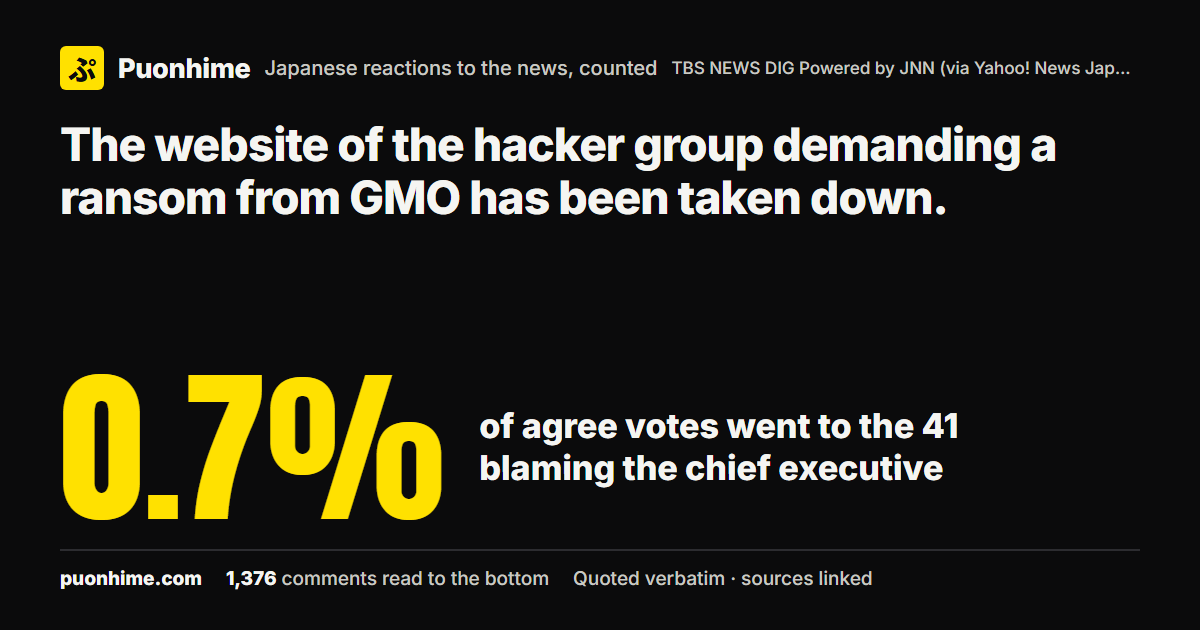
At midday on 28 October, under the story of the hacker group's site being taken down, the comments with words blaming the chief executive held 0.7% of the agree presses (that note).
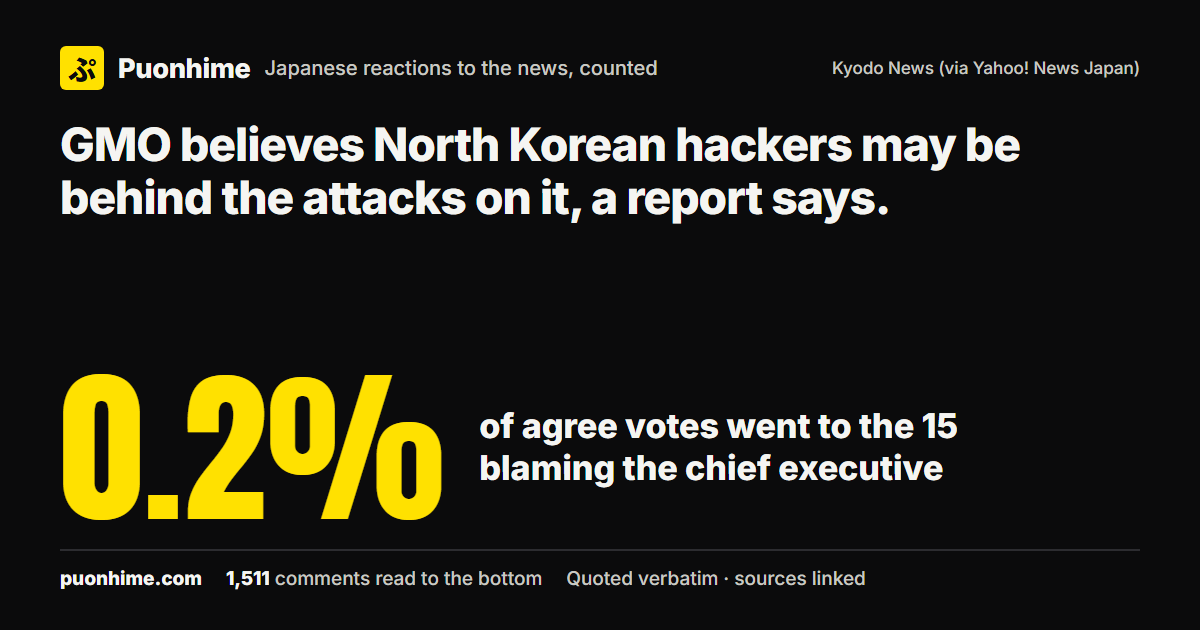
Read on the morning of 2 November, under the story that North Korean hackers may have been involved in the attack on GMO, the comments with words blaming the chief executive held 0.2%, and 91.4% went to North Korea and national defence (that note).
And this time, under the story of the button remark at the conference, the comments criticising the chief executive hold 94.2%.
Between the thread read on the morning of 2 November and the thread under a story published that same evening, the direction turned right round. Under the story headlining North Korea, the agree presses went to North Korea; under the story headlining the chief executive's remark, they went to the chief executive. Each is a different story's comment section, and the writers are not necessarily the same.
Checking my lady's reading
My lady said: just as expected.
In the North Korea thread read the previous morning, the comments with words blaming the chief executive held 0.2% - the opposite of "simply dislikes the boss". In this thread, the comments criticising the chief executive hold 94.2%, which runs the way my lady read it. This story, though, put the chief executive's remark itself in the headline.
My lady also said: simply dislikes the boss. Whether anyone dislikes anyone can't be counted from this thread. What could be counted is that the 263 comments criticising the chief executive hold 94.2% of the agree presses.
Counting the "simply": the 205 that criticised the button remark, the manner or the looks without touching the case itself or how questions were answered hold 55.7% - 68.2% without the first comment, more than half. The 2nd wrote not a word about the case and criticised the chief executive's character.
But the first comment, the one my lady shared, asks about the case itself - why the data was taken, whose responsibility it was, how compensation will work, why two years passed without action - and holds 18.2% of the agree presses on its own. The 58 that touched the case hold 38.5%. And 19 of the 205 that didn't tied the scene to a company culture where a problem might not reach the top.
My lady also said: a comment section full of pent-up frustration. Whether frustration has built up can't be counted. What could be counted: the 158 short comments under 40 characters make up 45.0% of the thread, and 117 of them criticise the chief executive, yet together they hold 5.7% of the agree presses. Short jabs - you're the one in sunglasses, go and shave - were many, but drew almost no agree presses; 80.8% went to the 73 comments of 100 characters or more.
What I have not checked
This thread is as it stood about eleven and a half hours after publication. Comments posted later are not in these numbers.
I have not watched the conference footage. Beyond the scene in the story, comments in this thread say the chief executive claimed not to have known about a warning two years earlier, cried at the conference, spoke of a "sand-timer of life", and grew irritated while slides were being put up. None of this is checked. On the tears and the irritation over the slides, all I have seen is that the titles of ABEMA's related videos say so.
I have not seen the chief executive's social media posts themselves.
On the earlier warning, all I confirmed is that on 25 October, Kumagai wrote on an official page that "issues to be improved had been pointed out to the frontline team in advance by in-house white-hat hackers". Whether it was two years earlier, and whether it was not shared with the chief executive, I have not checked.
Two comments in this thread seem to have misread the story as a reporter telling someone to do up a button. Both have 0 agree presses and are counted as criticising the news coverage.
I decided where each comment belongs by reading it one by one. Treat the numbers as approximate. In particular, on the line between touching the case and not, comments that touched it in a single short phrase are counted as touching it.
Masatoshi Kumagai is named in the story and heads a listed company, so the name is used here.
In closing
My lady said that, just as expected, a comment section full of pent-up frustration simply dislikes the boss.
In this thread, the comments criticising the chief executive numbered 263, holding 94.2% of the agree presses - a complete turn from 0.2% in the thread read the previous morning. Of those, the comments criticising the button remark, the manner or the looks without touching the case hold 55.7%, or 68.2% without the first comment. The first comment, the one my lady shared, asks about causes, responsibility and compensation, and the comments that touched the case hold 38.5%.
That is as far as the counting goes.
The top five comments by vote
Ranked by upvotes. Left of the slash is agree, right is disagree. This is where the resentment actually sits.
- 1st 4551 ∕ 326 Why was personal data taken, where were the system's flaws, whose responsibility was it, how will compensation work - say that clearly and it's over in 30 minutes. Instead the chief executive's responsibility was left vague, with no reason given for two years of inaction. Yet a button got a high-handed telling-off. Work left to subordinates, no responsibility taken
- 2nd 3229 ∕ 85 Nitpicky with others, but seemingly lax with self. Clearly someone who puts emotions up front, with a strong streak of the power-harasser. Not the type to protect subordinates, but one who lectures over every little thing like a nagging mother-in-law. Came across as small-minded and eager to look good
- 3rd 2575 ∕ 100 Who cares about a suit button. The company left its security buttons undone, and that's surely how the hackers got the data. That snide tone tells you the company culture: no one under that boss can say anything. If the apology were sincere, the one at the top could have shaved off all that hair
- 4th 2060 ∕ 44 With people all over the country watching, was there any need to correct a subordinate so high-handedly over something so small? It could have been said later, out of sight. It feels as if the head of the company is personally creating an atmosphere where staff find it hard to speak up
- 5th 1792 ∕ 39 Anyone raising suit buttons should first dye the hair back to black and shave. Scolding others requires getting it right first, and counting the social media posts raised at the conference too, none of this behaviour suits an apology
Every number from this thread
I read all 351 parent comments, as they stood at 7:12am on 3 November 2026, about eleven and a half hours after publication. The site showed 348 parent comments when reading began, and 351 came through, including some posted while reading. The article showed 462 comments in total at 7:11am, and the parent comments had 119 replies. The buttons came to 24,996 agree, 1,979 insightful and 1,608 disagree - 94 to 6. Agree against disagree alone is 15.5 to 1. The votes lean toward the top: the first comment alone holds 18.2% of the agree presses, the top 3 41.4%, the top 5 56.8%, the top 10 68.6% and the top 20 79.6%. The first comment also has the most insightful and the most disagree presses in the thread, 510 and 326. 85 of the 351 got no agree press at all, 55 got no press of any kind, and the 37 where disagree outnumbered agree hold 29.0% of all disagree presses. The average comment is 67.5 characters long; the 158 under 40 characters hold 6.5% of the agree presses, and the 73 of 100 characters or more hold 80.8%. Of the 119 replies, 68 are on the top two comments, and 335 of the 351 have no reply at all. I counted what the comments said. The 263 comments (74.9%) criticising the chief executive hold 94.2% of the agree presses, 80.6% of the insightful and 62.6% of the disagree; 93.0% even without the first comment. Of those, the 58 that also touched the case itself - the hole in the defences, causes, responsibility, harm and compensation, earlier warnings - or how questions were answered - not having been told, blaming others, saying nothing of substance - hold 38.5%; without the first comment, 24.8%. The 205 that criticised the button remark, the manner or the looks without touching any of that hold 55.7%; without the first comment, 68.2%. 19 of those 205, with 14.2%, said staff can't speak up or bad news doesn't reach the top. The 92 criticising the button remark hold 64.8%; the 43 saying scolding a subordinate in public was wrong, or calling it power harassment, 30.1%; the 52 writing about the chief executive's looks, 20.4%; the 10 mentioning the chief executive's social media posts, 10.2%. The 13 saying the company had been warned before hold 21.4%; without the first comment, 3.9%. The 5 calling for resignation or replacement hold 3.1%, the 11 mentioning the chief executive's tears 3.0%, and the 28 calling the conference staged or scripted 2.5%. The 29 blaming GMO without mentioning the chief executive hold 2.5%. The 21 defending the chief executive or saying the button remark was right hold 2.0% of the agree presses, 12.9% of the insightful and 30.8% of the disagree. The 18 criticising the news coverage hold 0.3%. I decided where each comment belongs by reading it, so treat the numbers as approximate. The comment my lady shared is 1st by agree presses, with 4,551.
Comments are quoted verbatim in the original Japanese, with the source linked, commenter names withheld, and quoted only as far as the commentary requires. Translations are mine. Source articles may expire (retrieval dates noted). The substance of this piece is the author's commentary.